My Media Portfolio
P1: Understanding Script Elements in a Range of Media Products
Script Title: Titanic
Author: James Cameron
Web Link: http://www.dailyscript.com/scripts/Titanic.txt
Style: The script of titanic uses different styles of language, as the film portrays the contrast between upper and lower class characters. When those of a lower class are in conversation terminology is extremely basic and most sentences include at least one form of slang. Sentence structure is basic to imply those of a less educated background and action is detailed describing a loud atmosphere filled with live music. The scene is described as “rowdy” implying those of a lower class as they are often represented as troublesome, in contrast to those of an upper class, where scenes are calm with a relaxed atmosphere and classical music. Language within dialogue of someone more upper class includes correct pronunciation alongside a posher tone of voice. The action is written in present tense and again language varies depending on the class of the character within the scene. The writing style is different to a novel, as the action can be developed as much as the actors like and can be shown thoroughly through technical codes such as camera movements and angles and visual codes such as the characters facial expressions and body language alongside the dialogue.
Content: In the scene where Jack and Rose visit the third class general room, the amount of dialogue is shared equally between Jack, Rose and any other characters involved. Conversation between the 2 is simple and emotion is conveyed through technical, visual and audio codes such as music, rather than dialogue. The scene is labelled “third class general room” implying a very basic room for very basic people who aren’t particularly made a fuss of. The action is extremely detailed and includes other characters stories to imply their class and mood. When a drink is spilt across Rose’s dress, she laughs however Tommy becomes angry extremely quickly and violence is soon introduced to the scene. Jack stops this by reminding the pair of a funny story and soon the situation is calm. The quick use of violence implies those who are heavily involved with alcohol and therefore lower class as they don’t see violence as an issue, unlike those of a higher class where violence is disregarded. Jack addresses the fighting pair as “boys, boys!” also implying those of a lower class, as they are addressed as boys, rather than men which in society suggests one who is not as well-respected or educated as a man. Lack of parentheticals in this section of the script allows the actors to put their own emotion into it and feels more natural to the audience.
Narrative Structure: The narrative is single stranded as we follow the journey of the 2 main characters. As it is based on true events, the film is focused on this situation and therefore has no room for other narrative strands. The script is linear however starts non-liner as technically the whole film is a flashback for the female character we see right at the start. Although the film starts by showing boat wreckage and items classed as evidence, this doesn’t have an impact on the narrative structure, as it is to set the time in which the film has been made. The whole film is in fact flashback of the lady who survived the Titanic, Rose and she then leads us on to the actual story of the Titanic. Titanic does follow Todorov’s theory as at the start of the film the boat is new and ready to set sail for the first time. It is iconic in history for the first boat to be built supposedly “unsinkable” however this becomes an untrue fact and this is where the main disequilibrium is shown. Even though throughout the film we see many small disequilibrium’s, such as Rose being unhappy in her relationship, the main disequilibrium is when the ship hits the iceberg. The problem is recognised as life jackets are handed out and emergency boats are lowered to sea with passengers on board. Because this is a true story set in 1912 and the danger escalates quite quickly, there are no emergency services etc to help “repair” the situation as such. Even though women and children are rescued from the disaster, Rose is determined to stay with Jack, who is not a priority to be rescued considering he is an adult male, of a lower class. Rose has no choice but to exit the titanic and is left floating on a piece of board awaiting help, as Jack has no choice but to drown to be able to save Rose. As this is a flashback, we don’t see the further stages, eg the new equilibrium, however do see Rose now, who is giving her opinion on the situation. This is similar to the Freytag Triangle as there is exposition at the start where everyone is boarding the Titanic ready to be a part of history (an unsinkable ship) , followed by rising action, as Jack and Rose become closer and the audience believe there will be further conflict between Jack and Rose’s fiancé and then the final climax where the ship starts to sink. The falling action is covered as Jack tries to save Rose and other passengers are trying to escape the sinking ship, however because this is a true story and back in 1912 there were no methods of immediate help, there is no specific resolution.
Genre: The main genres of this film are Drama and Romance; however it is based on a true story. The script uses typical conventions of the Romance genre such physical contact between Jack and Rose and camera angles and movements that portray the couple as close and intimate. Point of view shots are used throughout to show the direct address between the 2 characters and allow the audience to engage with the relationship between the 2 as we put ourselves in the position of either character. As the film is based on true events, the film is non-fiction however points and events have been elaborated on to create an engaging storyline. Titanic also displays the dominant ideologies of people within the different classes in society, both then and now. The setting changes to show the contrast of the people on the ship; for example, in upper class there is extremely expensive-looking furniture and décor including a grand wooden staircase. Carpets are patterned and colours are old-fashioned to imply the period the drama is set in. This also applies to the costume and make-up used throughout the film.
Target Audience: Personally I believe the target audience of this film is extremely broad; firstly, those who were alive when the incident happened will be interested to find out the storyline behind the 2 main characters specifically. No matter what class they are within today’s society, they will want to reconcile about the events. Older adults, both male and female, may be interested in watching the film as their parents/grandparents may have been either involved or around when Titanic sank, giving them inspiration to watch the film. Typically those of a younger age may watch the film because of the genre, rather than the narrative being based on true events, therefore the younger target audience would be predominantly female, especially as females are stereotypically more interested in films of the romance genre. A secondary target audience may be those who are interested in history, or how people were treated differently in society back in 1912 as the film displays clear dominant ideologies and representations of each class within society.
Script Title: Some Girls
Author: Bernadette Davis
Web Link: http://downloads.bbc.co.uk/writersroom/scripts/some-girls-s1-ep1.pdf
Style: Some girls is a comedy show on BBC3 that follows the lives of 4 teenage girls who live in and around a stereotypical British Council Estate. Generally the characters are laid back and the show reflects the ideologies of teenage girls of a lower class that live in an area classed as “rough”. Stereotypical language such as slang is used throughout and jargon is used throughout to imply the age of the characters. The language also contributes to the ideologies being presented, as the characters often don’t pronounce each letter within a word, something common in people classed as “chavs”. The action mainly focuses on one character and is present tense. Key details are pinpointed such as any characters not involved in the dialogue, their body language, facial expressions and attitude within the scene. For example, in the changing rooms, Aliyah is also present. She is described as “much younger, not part of the gang and sitting on the bench in her coat with her bag. She is a small Muslim girl wearing a veil, the full niqab where just the eyes are showing. Her eyes are large and expressive flicking back and forth between the girls as she takes it all in”. This implies Aliyah is nervous and slightly uncomfortable with the situation that she is in and therefore allows the actress to portray these emotions to the audience.
Content: Scene titles are simple and instantly imply the genre and scene, for example the first scene is set in the Changing Room which is a typical location for the narrative, as teenage girls are likely to all be in the same changing room whilst at school etc. There are hardly any parentheticals to allow the actresses to get into character and play the role how they feel is best. If the lines aren’t set in stone and extra detail is added, this allows the cast to play on their tone of voice etc depending on the situation. There is a voice over to brief the audience on the characters so that we know more information straight away, and also add a comedic effect as the characters are telling the audience things about their friends that they wouldn’t particularly want to hear.
Narrative Structure: Some girls is a linear script however each episode does not necessarily continue on from the net. Events often do not continue like a crime drama for example would. The episode is technically single-stranded however the series is multi-stranded as each episode reveals a different situation, issue and solution within the group. Each girl in the group has an issue within the episode so the episode follows the Freytag Triangle multiple times (one for each character and their issue).
Genre: This script is non-fiction as it is based on everyday life situations, and is mainly a comedy. Comedy genre conventions are included throughout, especially as one of the main characters is blonde, they really take advantage of the common ideology in society that blondes are dumb. Her dialogue is always comedic as she points out the obvious and most of the time questions the others on their intelligence. There is a lot of jargon and slang which is good to represent the youth of today as it is a common feature in society.
Target Audience: The primary target audience for Some Girls is likely to be teenagers as they can then easily relate to the storyline etc. Also, the show is featured on BBC3 which features shows mainly targeted at the younger audience. This is supported by the fact that BBC3 is now online only, which is more convenient and relatable for the younger target audience as they are known for using the internet a lot. The secondary target audience may be slightly older adults, between 25-36 year olds as they reminisce over their school days and are reminded of what it’s like being at school. The show also mocks the teenagers at times, therefore attracting an older target audience. People of a higher class or with a higher spending power are unlikely to watch the show as it is on BBC3 which is aimed at a younger audience and refers to those of a lower class with crude humour and strong language (at times).
Script Title: Bridesmaids
Author: Annie Mumolo
Web Link: http://www.imsdb.com/scripts/Bridesmaids.html
Style: The language throughout is simplistic and represents the character as working class. In the scene where Annie goes crazy at the baby shower, there are loads of adjectives and descriptions that make Helen and Lillian extremely high class; the hotel is described as extravagant and the furniture is described as “marshmallow puffy” implying that the characters have high standards and needs for top quality items etc. Swearing is used throughout the film but normally for a comedic effect and to exaggerate terms and situations also implying the comedy genre of the film.
Content: There are minimal parentheticals to allow the actors to exaggerate as much or as little as they like and get into the situation more thoroughly. Pauses are used for effect in awkward situations, for example the opening scene when Annie is told that the man she spent the night with isn’t ready for a relationship, and also when Annie forces Lillian to think about the quality of their friendship. This allows the audience to think about how they’d feel in the characters position and helps the audience to engage with the film. Camera directions are also basic but allow the actors to understand what’s going on in the scene elsewhere.
Narrative Structure: The script for Bridesmaids is linear as we see the build up to the engagement, hen do, shower and finally when Annie makes Lillian question their friendship. Obviously as they’re meant to be beset friends they resolve their issues and this is when we see the resolution. This includes the actual wedding which Annie does attend as maid of honour. Bridesmaids is single stranded as it is based on one story and the journey of 2 best friends. The narrative structure follows Todorov’s theory as the best friends are living happily, then Lillian gets taken over by one of her other friends (Helen) and this distances Annie from Lillian. This becomes the disequilibrium as we see Annie become angry because Helen is in the way of the friendship. The problem is recognised when Annie kicks off in front of everyone at an event specifically for Lillian and the repair stage is when the two forget their differences and decide to not let Helen get in the way of their friendship.
Genre: The main genre of the film is comedy; however there are aspects of romance in it between several characters. The film uses alcohol as a way of bringing humour into the film and also plays on the fact that one of the characters is blonde and therefore uses her as a comedy target. The film is non-fiction as it is real life situations however there is extreme exaggeration in some scenes and situations. The comedy genre is also hinted by the use of location, for example Las Vegas is somewhere quite upmarket and modern. This implies the characters are going there for fun and to general have a laugh.
Target Audience: The target audience for this film would mainly be females, as they stereotypically enjoy films about female friendship groups as they can relate to the storyline etc. Those of a higher class/lifestyle may not particularly enjoy this film as at times it represents women negatively within society and to be quite careless, something not found in women of a higher class. With regards to age I belive the target audience of women would cover anyone from 16-45 as there are women of all ages within the film. Men may also watch this film if forced by a close female and therefore could possibly be a secondary target audience.
P2: Generate ideas for an original short film in response to a client brief
Script Treatment 1
Author: Charleigh Hobbs
Working Title: Lost and Found
Genre Elements
The main genre of this film is drama as we follow 85 year old Jean through her personal journey as she remembers the good times she spent with her husband. This heart-warming story exhibits an extremely common real-life situation, as Jean suffers from vascular dementia and experiences stressful situations on a daily basis.
Dementia can take control extremely quickly however the memories are still stored in the brain- even though sometimes sufferers can’t remember events that have happened within the last day or week, often fragments of memories from years ago return fresh in the mind. It is important to understand the confusion and stress that sufferers experience every day but also remember that they’re still the same person with the same memories inside. Jean’s journey shows the build up to a happy life; however it’s all in her mind creating an emotional experience/journey for all.
Central Theme/Conflict
The main theme in this film is mental health/illness as dementia takes control of the main character, however there are aspects of bullying and violence as there is conflict between relations to Jean. We see the consequences of general bullying throughout the story however the main focus is the effect of dementia on someone as a person and how it can affect the life of so many in such little ways throughout the day. As this story touches on health issues, the most conflict is the conflict that the character has with herself as she battles her painful memory loss.
Synopsis
Jean gets up every morning not knowing what day, time or century it is and is cradled with carers, support workers and long lost family. Jean regularly takes part in activities within the home continuing her passion for the piano and meets new people every day however longs for the relationship she had with her husband. As Jean lays in the summer sunshine she relives her search for love travelling over 100 miles to the welsh coast. With her satchel on her back and her book in hand Jean makes her way to the sea to find her everlasting love but will she get her happy ever after?
Key Characters
Jean: Jean was born in the tranquil village of Stanton Fitzwarren and grew up wanting to be a singer. From an early age Jean was captivated by the sound of the piano and wanted to travel the beautiful English and Welsh countryside, but her parents could barely provide for the basic needs and her 3 younger brothers soon became more like sons. At the age of 23 Jean fell in love with her future husband and they travelled the Welsh hills together as her passion for music increased.
Arthur: Arthur is Jean’s long lost husband who from a young age worked on the family farm to be able to provide for the family. Arthur’s main passion was art as he enjoyed studying the countryside and putting all his emotion into paintings. Arthur’s mother never wanted him to find love and their relationship soon faded when his mother was diagnosed with terminal cancer, leaving Jean as his main support.
Peter: Peter trained Arthur in their workplace however never liked Arthur’s enthusiasm and passion for his work. His jealousy increased over time for the settled lifestyle that Arthur had with Jean and soon turned to bullying him and emotionally blackmailing him to bring Arthur down. Peter becomes besotted with Jean but Arthur refrains from any physical fighting so emotionally breaks down as he fears he’s not good enough for Jean and Peter is determined to get rid of Arthur for good. He has a nasty tongue and an ever-increasing ego.
Script Treatment 2
Author: Charleigh Hobbs
Working Title: Finding myself
Genre Elements
The main genre of this film is drama as we follow a real-life situation of a lost teenager who has finished her studies but doesn’t have a solid decision on her future. As Annie has come in to a large amount of money we see her experience a large amount of pain and heartache, but also excitement and determination as Annie begins her journey.
The streets of London are crowded and Annie is on an emotional rollercoaster as she feels lost in the big city. She has ups and downs, some downs so low that she questions her emotional stability, however the city spirit soon lifts her up and puts her back on the right tracks.
Central Theme/Conflict
The main theme in this film is transformation of her as a person as she finds love for people, places and things she never thought she would. Annie goes through a phase where she literally hits rock-bottom, and she allows those around her to take control by encouraging her to do drugs and therefore suffering the consequences. Annie begins gambling, however this takes a turn for the worse and she starts to become addicted in a very short space of time.
Synopsis
Annie has always had a passion for science, however has always been at battle with her parents who are firm-believers of God and his powerful ways. Annie passes her driving test and celebrations are in order, however things suddenly take a turn for the worse as her and her parents are involved in a collision with a lorry being driven by a drunk-driver. Annie unfortunately loses both of her parents in the accident, however therefore inherits everything they own. Annie decides that God will not control her life anymore, as he has taken everything she had away from her, and makes the brave decision to travel the world to find out who she really is. As a result of her parents’ narrow-minded beliefs, Annie decides before she leaves the UK she needs to experience the different cultures closer to home, in the capital of her home country, London. Annie’s journey pushes her through tough times as she experiences a huge amount of trauma along the way, however Annie realises that money isn’t everything and it’s time to start making a difference to the world.
Key Characters
Annie: Annie has always had a sense of adventure but never had the money to travel the world. Her opinion is never valued within the home environment; however education has allowed Annie to express her opinions and has given Annie the urge to fight for what she believes in. She’s quite a closed person and is 110% focussed on her studies however feels as though she needs time to herself to express herself and learn to love the world.
Derek: Derek is temporarily homeless as he recently got out of prison for stealing. He has a clean appearance and his sleeping bag looks brand new, however is being dragged down by others that he’s previously been involved with. Derek lacks faith and optimism as his girlfriend stops him from seeing his 6 year old daughter and turns to drugs to distract himself. He’s always had a close relationship with his mum, however when she dies unexpectedly Derek is left heartbroken and alone.
Vicky: Vicky has always been a city girl, however is passionate to help the homeless; she volunteers in the local food bank and set up a homeless shelter. Similarly to Annie, Vicky lost her parents in a car crash when she was a lot younger and has grown up living with her auntie who is severely disabled.
Script Treatment 3
Author: Charleigh Hobbs
Working Title: Vacation
Genre Elements
The main genre of this film will be comedy as we follow the lives of 2 best friends, Matt and Chris. The comedy aspects will be based around the idea of them wanting to live life on the edge, as Matt recently got divorced and Chris has been single for over 15 years. Matt previously had a gambling issue, however Chris convinces Matt to buy one last scratch card after their night at the pub. The 2 are always joking with each other and often act like young adults.
Central Theme/Conflict
When flying to Barbados, Matt’s case gets lost. Someone else has picked up his suitcase, and he has collected an identical suitcase belonging to a stranger. However, as Matt soon realises, this case is stashed with alcohol and drugs and is left to try and get rid of it. Chris then sees a young lad with Matt’s case and they begin to chase him in their hire car. The getaway driver has obviously realised why they’re chasing him and drives as quickly as possible away from them. Using Apple’s navigation system, they track the other owner but have to overcome several obstacles in the way.
Synopsis
Life-long best friends Matt and Chris head to Barbados for a well-deserved break; Matt has recently got divorced after battling with an extreme gambling addiction and Chris has been, unsuccessfully, looking for love for over 15 years. After being convinced to buy one last scratch card, Matt is determined to put gambling behind him and have a good break with his best friend. However along the way they encounter many obstacles and their calm relaxing holiday turns into one long eventful journey thanks to another passenger who accidentally picks up Matt’s case, conveniently identical to his. As the police start to catch up with the pair after they let slip about the stashed drugs in the suitcase they’ve collected, time is running out to collect the right suitcase and return to the UK back on common ground.
Key Characters
Matt: Matt was married for 20 years however as a result of an extreme gambling addiction, his wife Laura decided that Matt was not made for family life anymore. He’s outgoing and hardworking however easily influenced by others, and overall is mainly just a big kid. He’s been best friends with Chris since they were 4 years old and always supported Chris through school as he struggled with everyday school life. Matt likes to think he has a good relationship with his 15 year old daughter Louise, however after Matt’s gambling addiction Louise resents him and has been bullied throughout her school life.
Chris: Chris has never been married however was engaged once in 1999, before he was cut off for being too lazy. Chris struggled through school and has never been academic, however doesn’t have much common sense either. Chris likes to socialise with friends and got to the pub on a regular basis to play darts. He’s constantly making jokes and trying to make friends however most of the time he feels alone and isolated.
Barry: Barry has always been one of the good guys however has been being blackmailed for several years and has therefore got involved with smuggling drugs into Barbados. He’s an older guy who also has been single for many years and has severe hearing loss but refuses to admit it. His diet is poor and his clothes are three times too small for him, however is a good guy deep down and through time manages to build a good relationship with Chris and Matt.
P3, M1, D1- Produce a script for a short film in response to a client brief


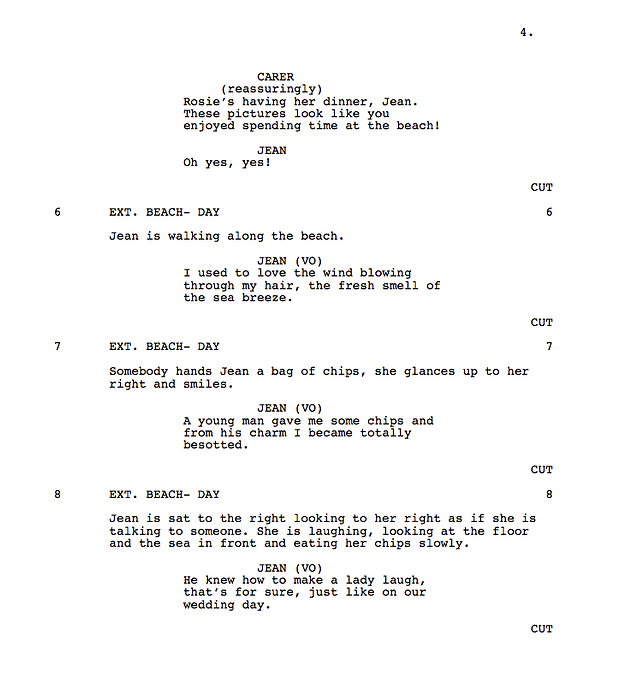

Shooting Script


TASK 4 - P4 - Pitch an Original Short Film Script for Feedback
Script Pitch Group:
-
Ian Szczebiot (teacher)
-
Hendry Lui
-
Jack Baker

TASK 5 - P5, M2 - Revise Original Script using Client Feedback Gained
Feedback Review Report


Revised Script


